Surgical Code Editing: The 10x Token Efficiency Pattern
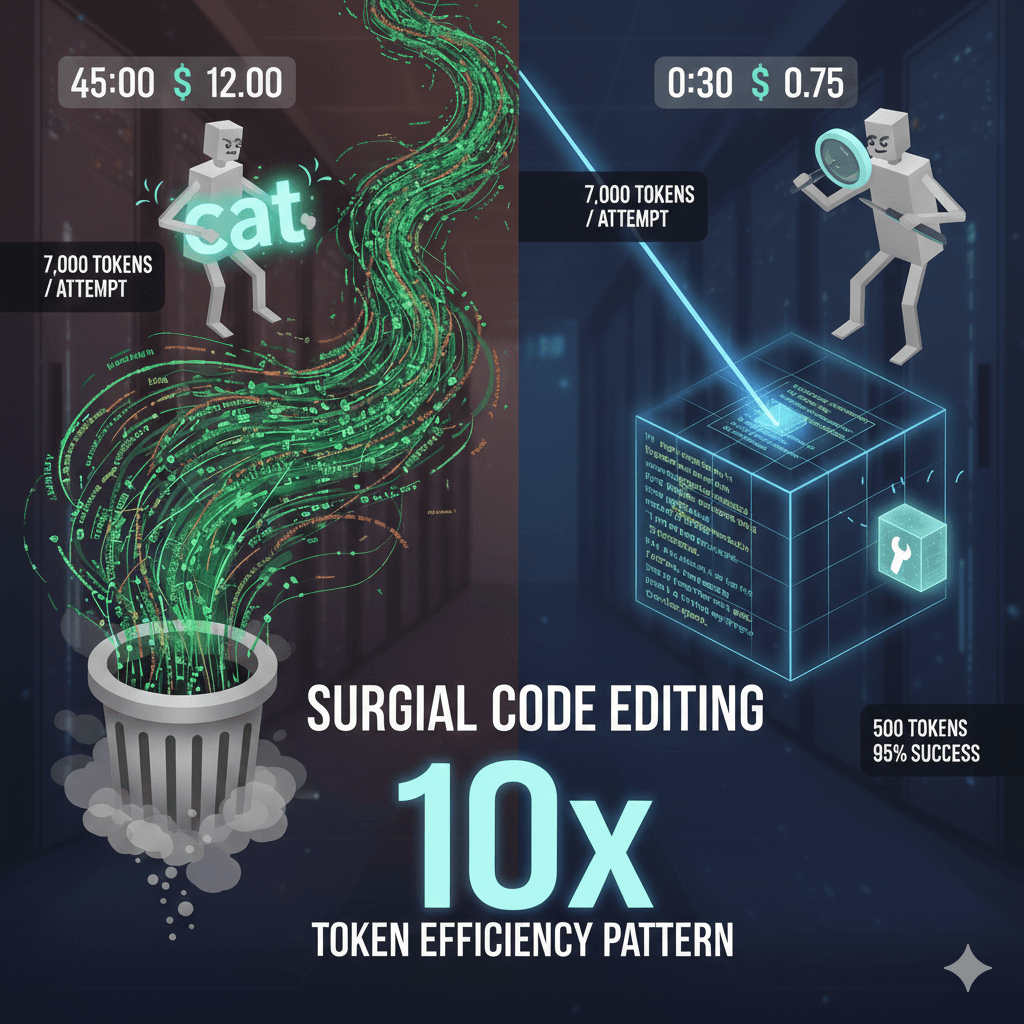
I watched an AI agent spend 45 minutes and $12 in API costs trying to add a single method to a service class. Not because the logic was complex. Because it kept using cat to rewrite the entire 500-line file.
Every attempt: 3,500 tokens to read. 3,500 tokens to rewrite. One syntax error on line 437? Start over. 7,000 tokens down the drain.
The same task with symbolic operations? 500 tokens. 95% success rate. $0.75.
This isn't about picking better tools. This is about fundamentally rethinking how AI agents edit code.
The Token Tax: Why Brute Force Fails at Scale
When AI agents edit code using bash utilities like cat, echo, and heredocs, they're performing full-file rewrites for every change. This creates a cascading efficiency crisis:
Cat/Heredoc Approach
Symbolic Approach
The math is brutal:
- 20x token cost for the same outcome
- 9.2s vs 1.0s execution time
- 60% success rate means multiple retries, compounding costs
And this is for a single file. In a real session editing 10 files? You've just burned through 140,000 tokens and $21 in costs.
The Five Deadly Sins of Cat-Based Editing
Token Gluttony
Full-file operations force the entire file into context, regardless of what you're changing.
1// You want to change THIS:
2async findOne(id: string): Promise<User> {
3  return this.repository.findOne(id);
4}
5
6// But cat makes you read/write THIS:
7[entire 500-line file with imports, interfaces, 15 methods, exports...]
The waste: 3,500 tokens to change 3 lines.
With symbolic operations, you operate on symbols (functions, classes, methods) instead of text:
Surgical replacement of a single method body
{
  "relative_path": "src/services/user.service.ts",
  "symbol_name_path": "UserService/findOne",
  "new_body": "async findOne(id: string): Promise<User> {\n  return this.repository.findOneOrFail({ where: { id } });\n}"
}{
"symbol": "UserService/findOne",
"lines_changed": 3,
"file_size": "12.4 KB"
}The efficiency: 250 tokens. Only the method you're changing enters context.
The All-or-Nothing Trap
When cat fails on line 437 of a 500-line file, you've accomplished nothing. The file remains unchanged. The tokens are spent. The context is polluted.
Contrast this with atomic symbol operations:
Key insight: When method 3 fails, methods 1-2 are already committed to the file and working. With cat? All 5 methods fail together.
Context Window Starvation
AI models have finite context windows. Claude Sonnet: 200K tokens. That sounds like a lot until you start reading files:
Context starvation leads to:
- Degraded reasoning ability
- Forgetting earlier context
- Failed multi-file edits
The Debugging Nightmare
When cat fails, the error is somewhere in 500 lines:
1$ cat > user.service.ts << 'EOF'
2[500 lines of code]
3EOF
4
5# TypeScript error:
6# user.service.ts(1,1): error TS1005: ';' expected.
7# ... could be anywhere in the file
When symbolic operations fail, the error is scoped to the symbol:
{
  "relative_path": "src/services/user.service.ts",
  "symbol_name_path": "UserService/create",
  "new_body": "async create(dto: CreateUserDto): Promise<User> {\n  return this.repository.save(dto)\n}"
}{
"error": "Type 'CreateUserDto' is not assignable to parameter of type 'User'",
"line": 2,
"suggestion": "Import CreateUserDto or adjust type"
}Debugging time: 30 seconds vs 10 minutes.
Cascade Failures
In a typical agent session, you're not editing one file. You're editing multiple related files. With cat, one failure destroys the entire session:
With symbolic operations, failures are isolated:
Technical Deep-Dive: How Symbolic Operations Work
The AST Foundation
Symbolic editing operates on the Abstract Syntax Tree (AST) rather than raw text. This is the fundamental paradigm shift.
When you read a TypeScript file as text:
1import { Injectable } from '@nestjs/common';
2import { Repository } from 'typeorm';
3
4@Injectable()
5export class UserService {
6  constructor(private repository: Repository<User>) {}
7
8  async findAll(): Promise<User[]> {
9    return this.repository.find();
10  }
11}
You see characters. The agent sees tokens (words, symbols, whitespace).
When you read via AST:
1{
2  "type": "SourceFile",
3  "statements": [
4    { "type": "ImportDeclaration", "module": "@nestjs/common" },
5    { "type": "ImportDeclaration", "module": "typeorm" },
6    {
7      "type": "ClassDeclaration",
8      "name": "UserService",
9      "members": [
10        {
11          "type": "Constructor",
12          "parameters": [{ "name": "repository", "type": "Repository<User>" }]
13        },
14        {
15          "type": "MethodDeclaration",
16          "name": "findAll",
17          "returnType": "Promise<User[]>",
18          "body": { "type": "Block", "statements": [...] }
19        }
20      ]
21    }
22  ]
23}
You see structure. The agent can navigate semantically.
Tree-Sitter: The Parser That Changed Everything
Tree-sitter is an incremental parsing library that powers symbolic operations. It:
- Parses code incrementally (updates only changed portions)
- Supports 40+ languages (TypeScript, Python, Go, Rust, etc.)
- Provides precise symbol locations (line, column, byte offset)
- Error-tolerant (can parse files with syntax errors)
Why this matters: Tree-sitter allows tools like Serena MCP to:
- Parse a 10,000-line file in milliseconds
- Extract symbol hierarchy without reading the full text
- Locate a specific method by name path (e.g.,
UserService/findAll) - Replace just that method's body while preserving everything else
The Serena MCP Architecture
Serena is an MCP (Model Context Protocol) server that exposes symbolic operations as tools:
15 MCP tools grouped into three categories:
Exploration (Token-Efficient Reads):
See file structure without reading content - 10-100x token savings
{
  "relative_path": "src/services/user.service.ts"
}{
"classes": [
"UserService"
],
"methods": [
"constructor",
"findAll",
"findOne",
"create",
"update",
"delete"
],
"imports": [
"@nestjs/common",
"typeorm"
],
"exports": [
"UserService"
]
}Result: 200 tokens to see the entire structure. No need to read 3,500 tokens of implementation.
Locate and read specific symbols with optional body inclusion
{
  "name_path": "UserService/findAll",
  "include_body": true
}{
"symbol": "UserService/findAll",
"signature": "async findAll(): Promise<User[]>",
"body": "return this.repository.find();",
"location": "line 12-14"
}Result: 300 tokens to read one method. Not 3,500 tokens for the entire file.
Editing (Surgical Modifications):
Replace entire symbol definition surgically
{
  "relative_path": "src/services/user.service.ts",
  "symbol_name_path": "UserService/findAll",
  "new_body": "async findAll(): Promise<User[]> {\n  return this.repository.find({ order: { createdAt: 'DESC' } });\n}"
}{
"symbol": "UserService/findAll",
"old_lines": 3,
"new_lines": 3,
"diff": "+ return this.repository.find({ order: { createdAt: 'DESC' } });"
}Add new code after a symbol without touching existing code
{
  "relative_path": "src/services/user.service.ts",
  "symbol_name_path": "UserService/findAll",
  "code_to_insert": "\n  async findActive(): Promise<User[]> {\n    return this.repository.find({ where: { active: true } });\n  }"
}{
"inserted_after": "UserService/findAll",
"lines_added": 4,
"new_method": "findActive"
}Safety (Impact Analysis):
Check what would break before making changes - critical for monorepos
{
  "symbol_name_path": "UserService/findAll",
  "relative_path": "src/services/user.service.ts"
}{
"references": [
{
"file": "src/controllers/user.controller.ts",
"line": 23,
"symbol": "UserController/getUsers"
},
{
"file": "src/controllers/admin.controller.ts",
"line": 45,
"symbol": "AdminController/listAllUsers"
},
{
"file": "packages/web/pages/users.tsx",
"line": 12,
"symbol": "UsersPage"
}
]
}Why this is critical: Before changing a method signature in packages/common, you can see every place that calls it across your monorepo. No surprises during build.
The Skeleton-First Pattern: Building Files Atomically
The skeleton-first approach is the key workflow pattern that makes symbolic operations shine. It's the difference between "write everything and hope" vs. "build incrementally and verify."
The Old Way: Monolithic File Creation
Token cost: 3,500 (write) + 3,500 (rewrite with fix) = 7,000 tokens
The New Way: Skeleton-First with Atomic Implementation
Token cost: 1,150 tokens for complete, working file. 6x more efficient.
The Skeleton Template
Here's what the Coder agent creates first:
1import { Injectable } from '@nestjs/common';
2import { Repository } from 'typeorm';
3import { User } from '../entities/user.entity';
4
5@Injectable()
6export class UserService {
7  constructor(private repository: Repository<User>) {}
8
9  async findAll(): Promise<User[]> {
10    return [];
11  }
12
13  async findOne(id: string): Promise<User> {
14    return null;
15  }
16
17  async create(dto: CreateUserDto): Promise<User> {
18    return null;
19  }
20
21  async update(id: string, dto: UpdateUserDto): Promise<User> {
22    return null;
23  }
24
25  async delete(id: string): Promise<void> {
26    return;
27  }
28}
Why this works:
- TypeScript can parse it (validates structure)
- All methods have correct signatures
- Minimal token cost (100 tokens)
- Ready for atomic method implementation
Then each method is implemented with replace_symbol_body:
Write Entire File
Skeleton + Symbol Replace
Key advantage: When method 3 has a type error, methods 1-2 are already complete and working. You fix only method 3 and continue. Total waste: 250 tokens. Not 3,500.
Real-World Impact: The Coder Agent
The Coder agent is a Haiku-powered implementation specialist that uses Serena MCP tools exclusively. It demonstrates the cost savings at scale.
Architecture Principles
Division of Labor:
- Sonnet/Opus (expensive, smart): Planning, architecture, decision-making
- Haiku (cheap, fast): Execution, mechanical changes, implementation
Cost comparison:
- Sonnet output: $15/1M tokens
- Haiku output: $1.25/1M tokens
- 12x cheaper for implementation tasks
The Workflow
Automatic Safety: Pre/Post Hooks
The Coder agent has automatic backups and validation via shell hooks:
Pre-Symbol Replace Hook (pre-symbol-replace.sh):
1#!/bin/bash
2# Automatically backs up file before ANY symbol operation
3BACKUP_DIR="$TMPDIR/claude-backups-$CLAUDE_SESSION_ID"
4mkdir -p "$BACKUP_DIR"
5cp "$FILE_PATH" "$BACKUP_DIR/$(basename $FILE_PATH).$(date +%s)"
6# Keep last 10 backups per file
7ls -t "$BACKUP_DIR/$(basename $FILE_PATH)".* | tail -n +11 | xargs rm -f
Post-Symbol Replace Hook (post-symbol-replace.sh):
1#!/bin/bash
2# Automatically validates TypeScript syntax after changes
3npx tsc --noEmit "$FILE_PATH" 2>&1 || {
4  echo "⚠️  TypeScript validation warning (non-blocking)"
5}
Result: Every symbol operation is automatically backed up and validated. Zero manual intervention.
Performance Metrics
Before Serena (Cat-Based)
After Serena (Symbolic)
Efficiency gains:
- 14x token reduction (63K → 4.4K)
- 13x cost reduction ($0.95 → $0.07)
- 35% success rate improvement (60% → 95%)
The Counter-Arguments
"But cat is simpler!"
Counter: Simpler for humans writing scripts. Worse for AI agents managing context.
Agents don't think like bash scripts. They:
- Have limited context windows (200K tokens)
- Pay per token (input + output)
- Benefit from precise error messages
- Need recoverable failures
Cat optimizes for the wrong thing: minimal keystrokes. Symbolic operations optimize for the right thing: minimal tokens and maximum precision.
"What about small files?"
Fair point. Files under 50 lines might be reasonable to rewrite. But:
- Consistency matters: Agents should use one approach, not switch based on file size
- Files grow: That 40-line file becomes 200 lines next month
- Token cost is token cost: Even 40 lines × 2 (read + write) = 80 lines = 800 tokens
With symbolic operations, 40-line file:
- Overview: 100 tokens
- Replace one function: 150 tokens
- Total: 250 tokens (3x more efficient even for small files)
"Setup overhead?"
Initial setup: Install Serena MCP, configure Claude Code to use it.
Time: 10 minutes, one-time.
Payoff: Every session after that saves 10-14x tokens.
ROI calculation:
- Setup time: 10 minutes
- Average session without Serena: 50,000 tokens ($0.75)
- Average session with Serena: 4,000 tokens ($0.06)
- Breakeven: 2 sessions
- Savings after 10 sessions: $6.90
Not to mention the time savings from fewer errors and faster debugging.
The Paradigm Shift: From Text to Symbols
The fundamental insight isn't about tools. It's about how we think about code.
Text-based editing sees code as:
- Characters
- Lines
- Strings to search and replace
Symbol-based editing sees code as:
- Functions
- Classes
- Methods
- Imports
- Relationships
This shift enables:
- Precision: Change exactly what you mean to change
- Safety: Impossible to accidentally corrupt adjacent code
- Efficiency: 10-100x token reduction
- Clarity: Error messages reference symbols, not line numbers
Actionable Takeaways
For Agent Designers
Build surgical tools, not copy/paste tools - Expose AST-based editing operations - Provide symbol location and navigation - Enable incremental, atomic changes
Optimize for token efficiency - Measure cost per operation - Design workflows that minimize context pollution - Allow partial success (atomic operations)
Build safety into the workflow - Automatic backups before edits - Syntax validation after edits - Impact analysis (find references)
For Agent Users
Question agents that use cat/echo for code
- If you see
cat > file.ts << EOF, that's a red flag - Ask: "Can this use symbolic operations instead?"
- Measure tokens spent on file operations
Look for symbolic/AST-based editing - Does the agent use tree-sitter or similar parsers? - Can it read individual functions without reading entire files? - Does it have "replace symbol" operations?
Measure tokens, not just "it works"
- Track tokens per session - Compare approaches (cat vs symbolic) - Calculate actual costs
For MCP Server Developers
The Model Context Protocol enables exactly this kind of innovation. If you're building an MCP server:
Expose high-level operations - Not just "read file" and "write file" - But "get symbols," "replace symbol," "find references"
Think about token efficiency - Can you provide the same information with fewer tokens? - Can you return structured data instead of formatted text?
Design for workflows - Not just individual tools - But sequences that work together (overview → locate → modify)
Resources
Tools and Projects
Serena MCP Server
- Symbolic code operations for AI agents
- 15 tools: exploration, editing, memory management
- Tree-sitter powered AST parsing
Claude Code
- AI-powered development environment
- MCP integration for extensible tooling
- Skills and agents for specialized workflows
Coder Agent
- Haiku-powered implementation specialist
- Skeleton-first approach for file creation
- Automatic backups and validation via hooks
Further Reading
Tree-Sitter Documentation
- https://tree-sitter.github.io
- Incremental parsing library
- 40+ language grammars
Model Context Protocol
- https://modelcontextprotocol.io
- Standard for AI-tool integration
- Growing ecosystem of servers
Token Economics
- Anthropic Pricing
- Claude model costs and capabilities
The Learning Paradox
Here's the counterintuitive finding: I learned MORE about code by writing LESS of it.
Because I wasn't spending tokens on mechanical file operations, I had context available for:
- Reading AI-generated patterns I'd never considered
- Discovering architectural approaches from the agent's suggestions
- Discussing trade-offs instead of fighting syntax errors
The token budget became a learning budget.
When every file read costs 3,500 tokens, you can't afford exploration. When it costs 200 tokens? You can read 17 files and still have context for reasoning.
Efficiency isn't just about cost. It's about capability.
The choice is yours: Keep using cat and burn through context like it's infinite. Or embrace surgical editing and unlock 10x efficiency.
The tokens you save might just change how you think about code.