The Game Engine Hiding Inside a React App

Open Guildhall and it looks like a small strategy game. There's a castle, a town, a crowd with daily routines, heroes walking out on quests, and weather.
Under the hood it's a React and TypeScript app, built with Vite and tested with Bun. There is a game engine hiding inside it, and most of this post is about how the two are kept from fighting.
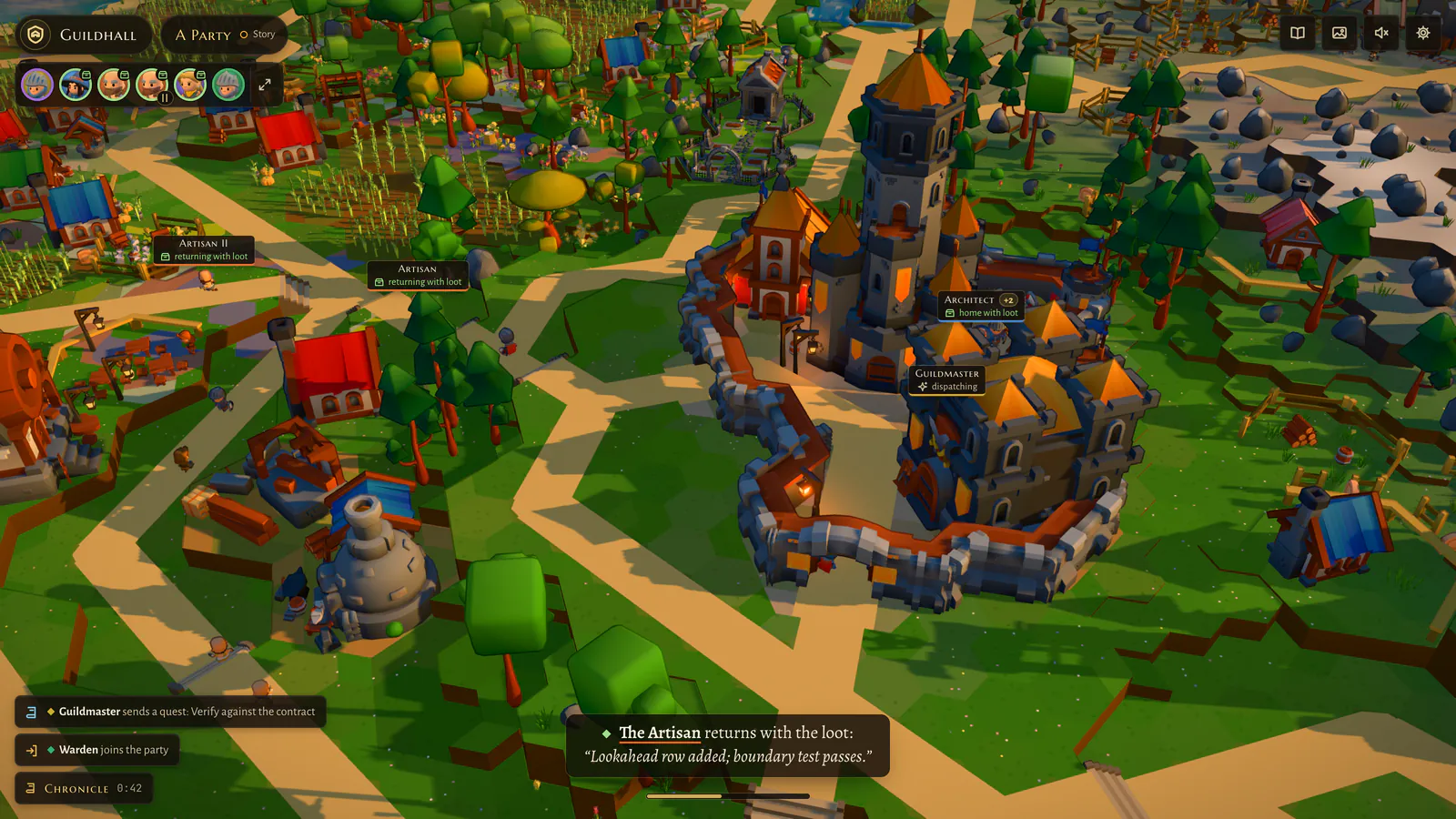
In the earlier parts I wrote about the hard problems: the Studio, procedural generation, collisions, animation, frame rate. This one is about the structure that held all of them up. It's the least glamorous part of the project and the one I'm most sure about, because it comes straight from experience and not from a prompt.
Two clocks that must not meet
A 3D scene and a React tree run on different clocks.
The scene draws every vsync, 60 times a second or more. Every frame the camera eases, a few hundred people take a step, the sun moves, the water moves. React works differently. Something changes, it reconciles a tree, it commits to the DOM. That's great for a settings panel and a terrible way to move 18,000 pieces 60 times a second.
So the first architecture decision (ADR 001, written as the V2 skeleton was laid) was blunt:
Apps are a React DOM shell that mounts render's Stage into a div. No R3F: the vanilla core owns the frame loop, and R3F's loop and reconciler would fight it.
”packages/render owns every three.js object. Its Stage is a plain object with its own requestAnimationFrame loop. Here is the heart of it (simplified from stage.ts):
1const frame = (now: number) => {
2  raf = requestAnimationFrame(frame);
3  // a skipped vsync: nothing drawn, no hook run, no GPU work
4  const every = Math.max(divisor, throttle);
5  if (every > 1 && vsyncs % every !== 0) return;
6  const ms = last === null ? 0 : now - last;
7  last = now;
8  if (holds > 0) return; // a loading cover is up: draw nothing
9  rig.update(ms / 1000); // the camera moves first
10  for (const fn of frameFns) fn(ms / 1000); // crowd, sea, sky, chips...
11  if (draw)
12    draw(); // the post pipeline
13  else renderer.render(scene, camera);
14};
No hooks, no state, no props. Modules subscribe with stage.onFrame(fn) and get back an unsubscribe function.
React only mounts it. The shell finds the screen the URL names, hands it a <div>, and keeps the teardown:
1useEffect(() => {
2  const target = screenFor(id);
3  const dispose = target.mount(host.current, {
4    query: params,
5    attach: debug.attach, // the stage goes to the HUD and window.guildhall
6    load: debug.load, // async work that guildhall.ready() waits for
7  });
8  return () => {
9    dispose();
10    debug.attach(null);
11  };
12}, [key, debug]);
That's the whole contract between React and the engine: mount, attach, dispose.
Layers that only point down
The monorepo is Bun workspaces: packages/*, apps/*, tools/* and live/*.
The order is core < assets < world < sim < render. A layer may import only the ones before it. ui sits beside render and may never touch three.js. Apps may never import three directly. Render is the only door.
The four bottom layers are pure: no three, no React, no node:*. That one rule pays three times. They run in a Web Worker. They run in bun test with no browser. And an agent working in world can't accidentally reach for the renderer, because the test fails.
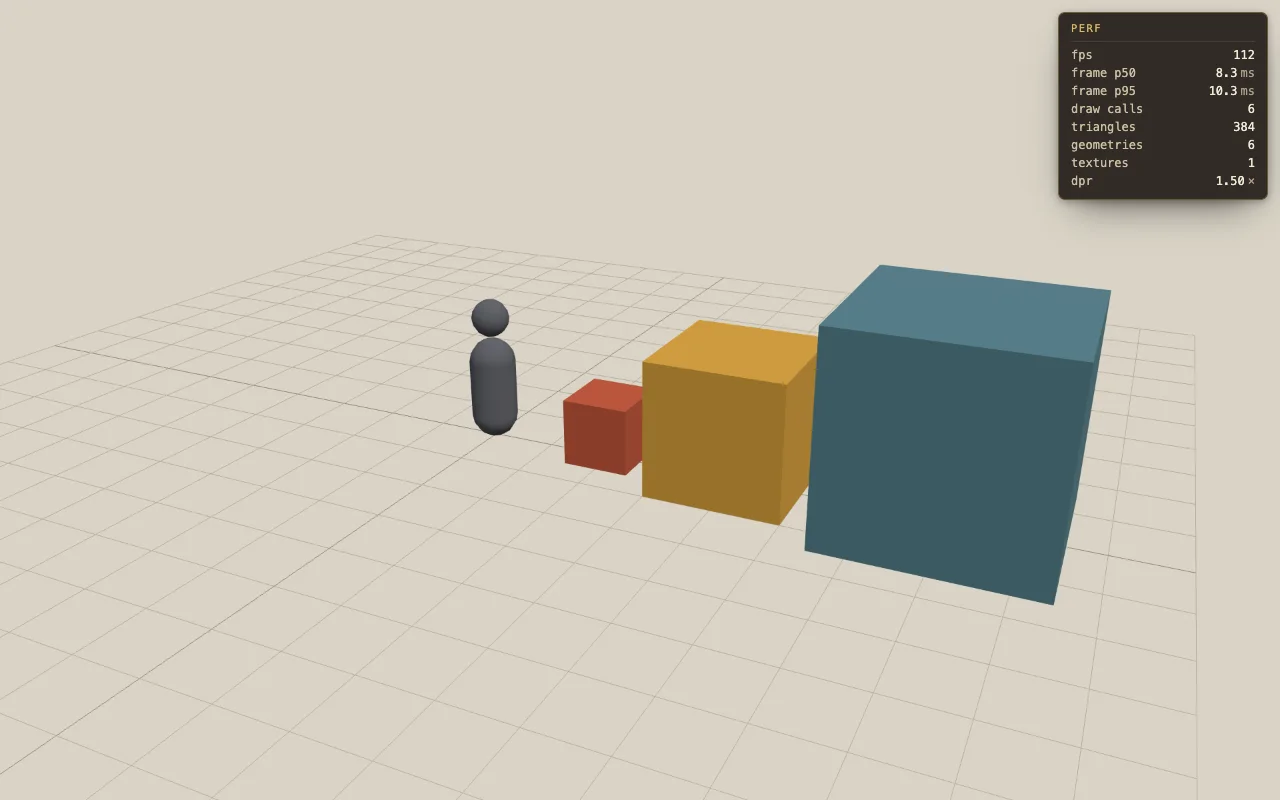
This is what the stage looked like on day zero of V2, before any world existed: a capsule, three boxes, and the perf HUD reading the stage's own numbers.
The world is a function of a seed
Every "random" choice in Guildhall is a hash. core/hash.ts is FNV-1a, and roll(seed, salt) turns a seed and a name for the choice into a number between 0 and 1. There's no Math.random() in the world. That means the same seed and the same repo size give the same island, on my laptop, on your phone, and in a test:
1test('same seed, same island', () => {
2  const a = hexIsland({ seed: 4 });
3  const b = hexIsland({ seed: 4 });
4  expect([...a.kind]).toEqual([...b.kind]);
5  expect([...a.level]).toEqual([...b.level]);
6});
Because the generators are pure, they can move off the main thread. The island screen starts a worker that runs the whole build (hexIsland, hexZones, hexWorld, the ground mesh, the placed pieces, the shore field, everyone's day plan). It posts the results back in stages as typed arrays, handed over and not copied. The main thread only uploads. The same worker then stays around to plan new heroes as a session's log grows.
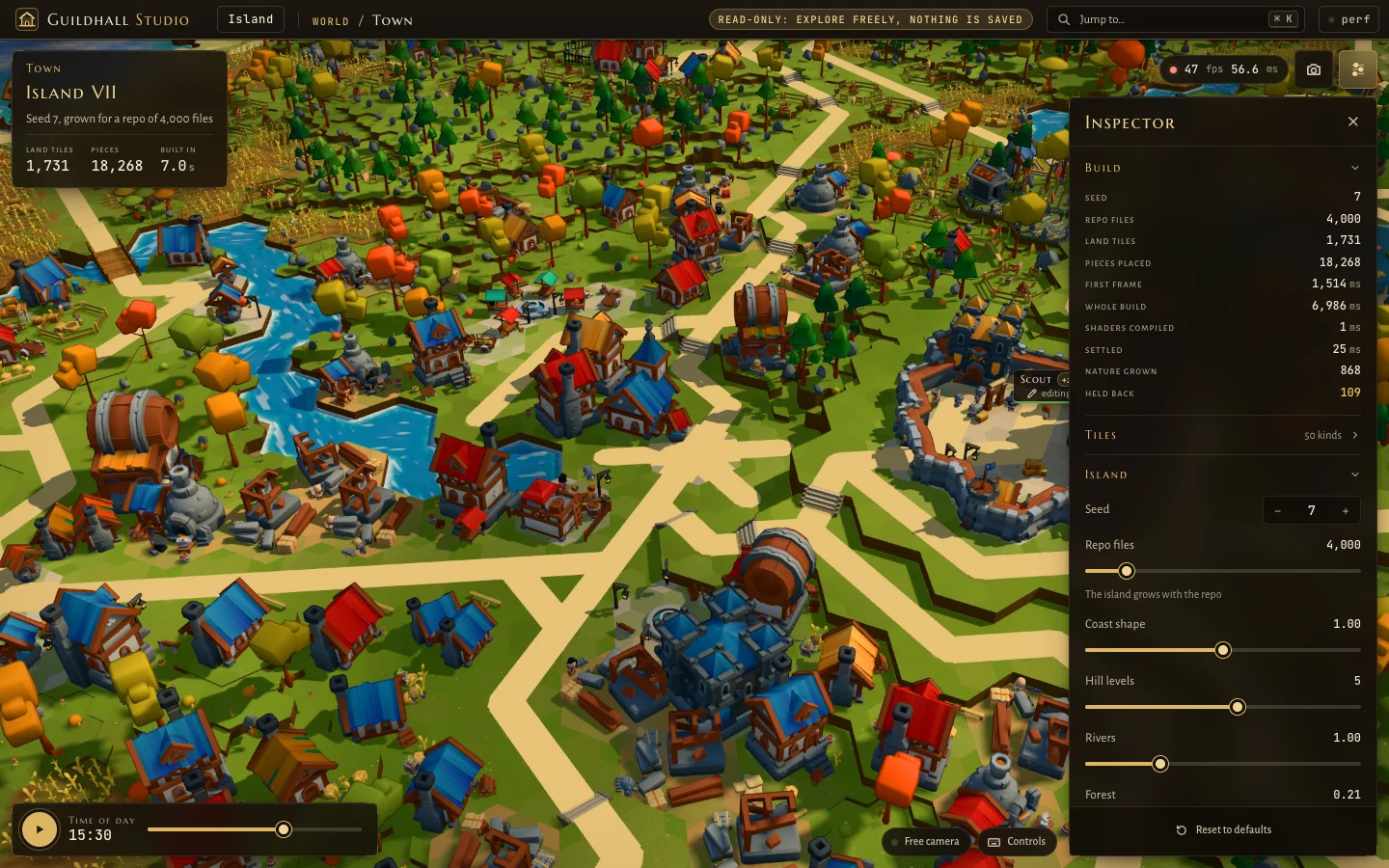
And because the world is a function of its inputs, a URL is a full repro. These are six real URLs on the live site, taken for this post:
How the HUD listens without re-rendering 60 times a second
The HUD still has to show live things: the clock, who's working where, the timeline, the frame rate. The rule is simple. The sim pushes, React picks a slice, and React only re-renders when its slice changes.
On the sim side, the guild's world is a reducer. reduce in sim/events/reduce.ts is pure and immutable, and it reads no clock but the event's own timestamp. So the world at time t is just the log folded up to t, whether it's playing live or being scrubbed. Selectors next to it (select.ts) turn that world into what the HUD reads.
On the React side there's a tiny store and one hook, built on useSyncExternalStore:
1/** One slice of the state: the component re-renders only when the slice changes. */
2export function useSlice<T>(store: Store, pick: (s: ViewState) => T): T {
3  return useSyncExternalStore(store.subscribe, () => pick(store.get()));
4}
Where a value changes every frame, the slice gets coarser on purpose. The history bar subscribes to the clock through a key that, while it plays, only changes when the rate or a jump changes. It doesn't change with every tick of time:
1useSyncExternalStore(clock.subscribe, () => barKey(clock.get()));
2
3// playing: re-render only on a rate change or a jump; at rest: on the time too
4const barKey = (s) =>
5  s.playing ? `play|${s.rate}|${s.jumps}` : `rest|${s.rate}|${s.jumps}|${s.t}`;
And the things that really do move every frame, the name chips floating over the heroes' heads, aren't React at all. They're plain DOM that the screen writes directly, with a declutter pass about ten times a second. The comment at the top of chip.ts says it outright: no React per frame.
One registry for every URL parameter
When everything is reproducible from a URL, the URL becomes an API, and an API needs a contract. Near the end, query parameters had spread across the codebase. The fix was one typed registry, apps/studio/src/params.ts:
1export const PARAMS = {
2  season: pub('any', 'A pinned season (spring, summer, autumn, winter)', text),
3  files: pub('any', "The island's size, as a repo of that many files", num),
4  collide: pub('studio', 'The collision layer overlay (knob)', one),
5  hud: dev('any', '=perf: the perf HUD from the first frame (tools/shots)', text, true),
6  // ...
7};
8
9const files = param(query, 'files'); // number | null: the parser's return type
(Simplified: the real descriptions are longer.) There are 86 parameters: 56 public ones that the site's links and Settings write, and 30 dev ones for shots, tests and perf tools. The dev ones only work on localhost or with ?dev=1, and anywhere else they're silently ignored. A test fails if any code reads a parameter that isn't declared here. The share card builds its link from publicOnly(query), so a debug flag never leaks into a link someone posts.
window.guildhall: a door for tools and agents
Part 1 was about giving the AI eyes. This is the hinge that made it possible. Every page exposes a small typed debug API, declared in core/debug.ts: ready(), camera.get/set, perf.now/sample, open(link), and an ext bag that screens fill with their own handles (the clock, the season, the life sim, the session, the FX, about thirty in all).
ready() waits until every tracked load has settled and two more frames have been drawn. So a script never shoots a half-built island. A real shot script then drives the world like this (simplified from tools/shots/living.ts):
1await page.evaluate(() => window.guildhall.ready());
2await page.evaluate((ms) => {
3  const s = window.guildhall.ext.session;
4  s.clock.seek(s.clock.get().end - ms, { jump: true });
5  s.clock.play(true);
6}, before);
7await page.evaluate((who) => window.guildhall.ext.camera.follow(who), heroId);
8await page.screenshot({ path: out });
The shots in this post were taken that way against the live site. So were the before/after sheets the agents had to look at before they could report a task as done.
Every screen is its own chunk
The site and the Studio are one app with fifteen screens: the island, the demos, the harbour, How it's built, a repo's hall, and the Studio's tools. Each screen registers in one line and loads lazily:
1lazy("composer", "Tile composer", () => import("./composer/index.tsx").then((m) => m.composer)),The import goes through ctx.load, so guildhall.ready() waits for it too. When I asked whether to split the Studio into its own site, the measurement said there was no need: the first load is the main chunk at 20 KB plus the shell and React at 126 KB gzipped, and each Studio tool is a 7 to 10 KB chunk that's fetched only when you open it.
The React side also adapts by itself. On a phone the same HUD collapses into a menu, a caption and a face bar, and the engine underneath doesn't know or care.
Why strictness made the agents fast
This is the part that ties back to the theme of the series.
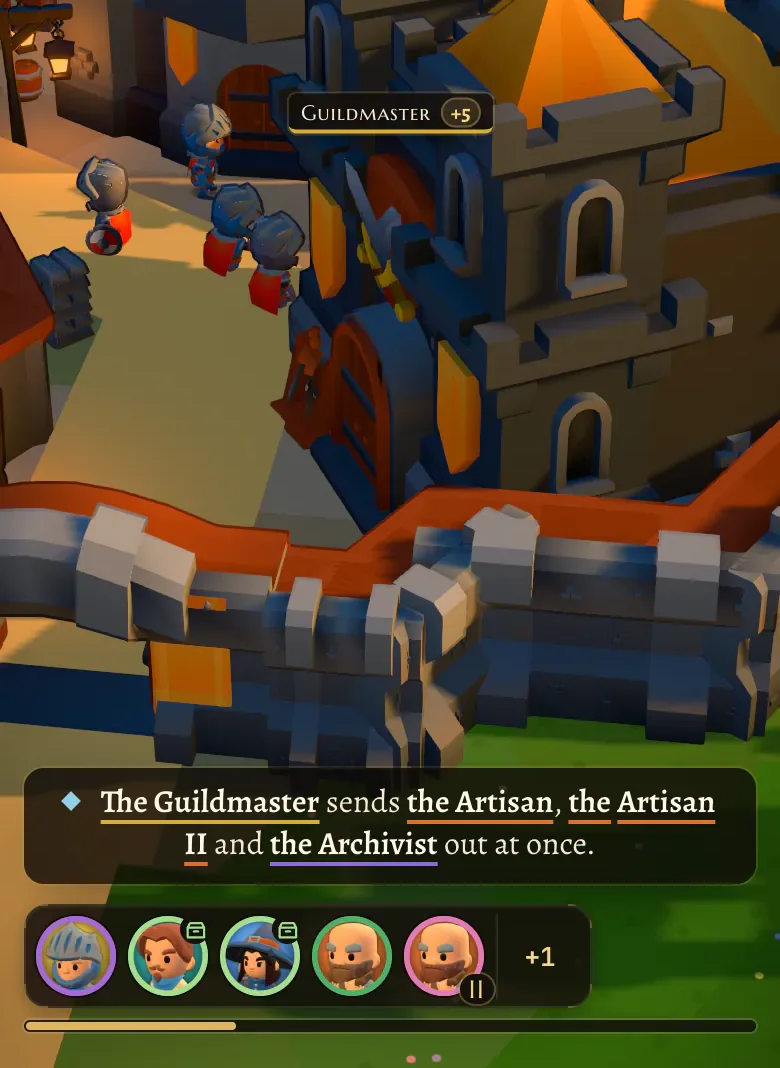
Guildhall was built with a lot of agents. One conductor session talked with me, kept decisions.md, wrote the task briefs, merged the work and ran the checks. Workers ran in parallel git worktrees, one task each: speed, crowd, prefabs, nature, collisions, procedural sites, scenes, the UI system, atmosphere. Every brief was a contract: what to read, which files it owned, what it must not touch, how it would be accepted, and what to report, including what it didn't achieve.
That only works if the codebase can say no without me in the room. Here's what said no:
- TypeScript at its strictest:
strict,noUncheckedIndexedAccess,verbatimModuleSyntax,noImplicitOverride, and project references, so each package type-checks as its own unit. A worker that changes a type inworldsees every broken caller before it reports. - Pure, deterministic modules. A pure function with a seed is the easiest thing in the world to test, and the easiest thing for an agent to reason about. The world tests don't check one example. They sweep seeds and sizes: no building over water, nobody standing inside a wall.
- The layer test. An agent can't "just import three" in the sim to fix something quickly.
- Biome for lint and format, and one command,
bun run check(lint, typecheck, test), as every brief's acceptance.
None of that is new. It's what I'd ask of any team I've worked on. The difference is what it buys with agents. A strict compiler and a fast suite are a reviewer that works at the agents' speed. Without them I'd have been the bottleneck, reading every diff. With them I could read reports and look at contact sheets.
The rules didn't all exist on day one. Each failure became one. An agent stopped processes by name and killed every dev server on my machine, including mine. The rule after that: stop only your own port or PID. Two agents edited the same island screen. The rule after that: name the owner of each file in the brief, keep shared files to wiring-only edits, and rebase before reporting.
If you want many agents in one codebase, make the codebase able to refuse bad work on its own: strict types, pure modules, a fast suite, layer rules as tests. Agents scale execution. The contracts are what keep that execution pointed in the right direction.
”The series, in one line each
- Give the AI eyes. The Studio came first, and every task ended with screenshots the agent had to look at.
- Procedural generation. Where the models failed most. Hexes, stacked relief, sites before roads, and growth that never moves old land fixed it.
- A Mario clone's lessons. Colliders and layers from a school Unity project, rebuilt as data and a test that must say zero, kept everyone out of the walls.
- Animation and timing. Every animation bug passed its tests. Only looking, frame by frame, fixed them.
- 60 fps. A measurement contract decided which of my ideas were real wins, and the look sheet had a veto.
- This one. A game engine inside a React app, kept apart by design and held together by types and tests.
AI is an amplifier
I tried the frontier models on Guildhall's hardest parts, and on those parts they failed again and again: plausible code, green tests, the wrong world. What worked was slower and more old-fashioned. I spent real time on the technical detail, made mocks and examples of exactly what I wanted, wrote precise contracts, and then let Opus and Sonnet do the typing at a speed I could never match alone.
The architecture in this post is the same story in code. Nobody prompted "keep the render loop out of React" or "make the world a pure function of a seed". Those came from years of watching projects rot when concerns tangle. Once they existed, the agents could move fast inside them.
AI amplifies whatever you bring to it. Bring experience and it builds a kingdom. Bring nothing, and it builds a very confident mess very quickly.
Thanks for reading the whole series. Guildhall is live at guildhall.codestz.dev. Open React's island at /hall/facebook/react, poke at the Studio, add ?collide=1 to a town and see the world the way the agents saw it. All the code, decisions file and journey notes included, is on GitHub.